

Grow your personal training business by setting clear goals, building a trustworthy brand, leveraging referrals, local SEO, and social media, scaling your sessions, and protecting your business with personal trainer insurance.
Sustainable fitness requires consistency. And so does growing your personal training business. If you want more clients and a steady income, it’s not as simple as “working harder” — it’s about strategically approaching your work like a real business. Start with these actionable steps.
Set a Clear Growth Goal for Your Personal Training Business
Just like you set goals with clients, the first step in learning how to grow your personal training business is to define what you want to achieve. Whether that’s filling your schedule with new clients, increasing rates, or hitting a monthly income target, make it specific and achievable. Then, commit to making it happen.
Pick one 90-day goal. For example:
- Add five new clients to my roster by [date]
- Expand my services by launching online training by [date]
- Generate [income amount]/month for three months
- Increase 1-on-1 session rates for new clients by X% by [date]
Your Action Item
Complete this quick exercise: “In 90 days, my personal training business will look like ______.” Use this brainstorm to set a clear business growth goal.
Example: “In 90 days, my personal training business will have 12 active clients, a simple referral process, and one small group session each week.”
Pro Tip
More clients, more locations, more services — as your personal training business grows, so do your liability risks! Personal trainer insurance is designed to offer essential protection against third-party claims of injury and property damage, so you can focus on leveling up.

Build a Professional Brand Clients Trust
Fitness journeys are personal, so your potential clients must trust your business before they book. Make sure your brand signals trustworthiness and real results. Then, focus on what makes your business unique to stand out from your competitors.
Check off these brand essentials:
✔️ Identify your unique value proposition (what you offer that no one else does)
✔️ Write a personal trainer business plan to guide your next steps
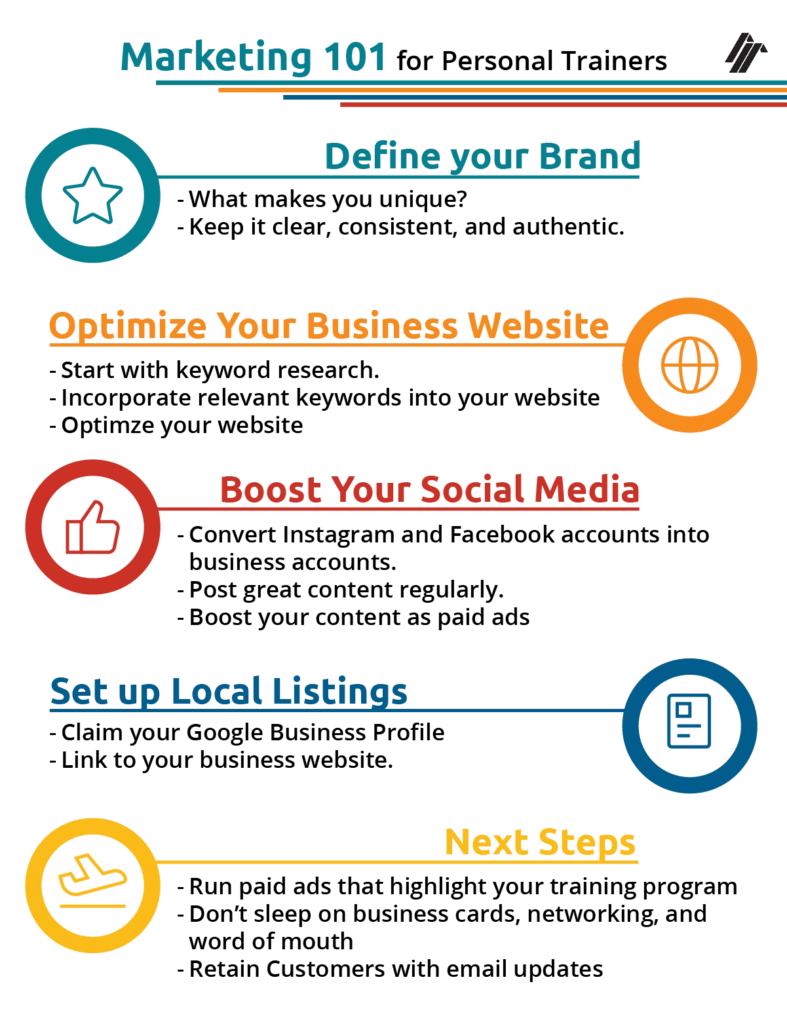
✔️ Keep your branding clear, consistent, and authentic
✔️ Build around one specific niche or specialization
✔️ Show proof with client testimonials and results
✔️ Install an insurance badge to boost trust further
Your personal training certification requires continuing education (CE) courses for renewal. To meet the requirement, consider investing in an earned specialization, which can help set you apart and empower you to support a client group with similar goals.
Specialization ideas:
One thing trainers overlook is positioning. Most trainers market workouts. That is easy to replace. Very few market a system, a process, or a point of view. Once we leaned into joint health, mobility, and pain resolution as our niche, everything became clearer. Pricing improved, retention improved, and referrals became more consistent.
Brian Murray, Founder of Motive Training
Your Action Item
Your clients’ successes are powerful — they help potential clients envision how your training can benefit them in real life. With their permission, track and share one client result story on your website and social media this week.
Not Certified Yet?
If you’re still exploring options before you start a fitness business, check out our guide, The Best Personal Trainer Certification Programs. Or jump to the most popular ones:
Gain More Personal Training Clients Without Burning Out
If your business goal is to get more new personal training clients, consistent outreach is essential. Remember: clients can’t book you if they don’t know about your services. So, aim for a dedicated “outreach time” goal, for example, for every three hours of training, do 30 minutes of client outreach and follow-up.
That doesn’t mean you have to burn out! Maximize your outreach efforts with these strategies.
Leverage Client Referrals
69% of personal trainers say they acquire new clients primarily through word-of-mouth referrals — these are your most valuable marketing tool. Let your clients know just how much your business depends on their referrals and offer a simple incentive whenever they send a friend your way.
It can be as easy as, “I’m opening two spots this month. Do you know anyone who’d be interested? You’re making killer progress, and I’d love to help anyone in your circle do the same.”
Your Action Item
Create a simple referral system and ask every happy client for a referral this week.
One of the most overlooked growth strategies in this industry is the power of referrals and, more specifically, the simple act of asking for them. Most of your clients genuinely want to help you succeed. They just need you to ask. A straightforward, heartfelt request like ‘Do you know anyone who could benefit from what we've built together?’ can open doors to clients who are already pre-sold on your value because someone they trust sent them your way.
Gerard Washack, Owner of Strong Republic Personal Training
Optimize for Local Visibility
To grow your personal training business through fitness marketing, you need to be visible locally. Start with your website and Google Business Profile, a free online profile that shows up when clients search for your business.
Your business website needs:
- A clear, easy path to book a session or program
- Client testimonials with results images or videos
- Proof of your credibility, such as your certifications and experience
- Keywords: Research what people are searching for online (i.e., “best personal trainer [your city]”) and incorporate these keywords into your website copy
Claim and optimize your Google Business Profile:
- Include all your business details, services, and pricing
- Add photos (training sessions, client transformations, etc.)
- Link to your website for seamless booking
- Ask clients to write reviews
The goal: a lead searches “personal trainer near me,” lands on your profile, sees that you’re a real, well-reviewed business, and clicks to book (or get more information).
Your Action Item
Set up your Google Business Profile and start collecting client reviews, which go a long way in legitimizing your business, so potential clients feel confident booking you.
Post Social Content That Reinforces Your Value
Post content on social media that shows exactly what you offer clients. Your videos, carousels, and stories all help to position you as the expert in your niche, with real client results to back up your offering.
Build awareness and connect with your audience. Try sharing content like:
- Simple fitness tips (“three mistakes beginners make”)
- Real coaching moments that humanize your business
- A client transformation story that inspires
- A series to hook your audience (“my client’s journey to [goal]”)
A simple weekly plan can look like:
- One results post
- One educational tip
- One personal, trust-building post
Your Action Item
Convert your personal Instagram account into a business account (or make a dedicated business profile). Then create and schedule next week’s posts in advance.

Increase Your Income Beyond 1-on-1 Sessions
If your business goal is to increase income, focus on earning more from the time you already spend training. Rather than packing in more one-on-one sessions and working longer hours, use these more sustainable strategies as you explore how to sell personal training.
Raise Your Rates Strategically
Raising your rates can feel uncomfortable, but it’s one of the fastest ways to increase income without adding more sessions. Here’s your reminder: your training expertise is valuable, and your time should be priced accordingly.
Small, consistent increases add up. Start here:
- Research the market (what are other trainers charging?)
- Calculate your target income (what do you need to charge to hit your goal?)
- Raise rates for new clients first
- Increase rates gradually (for example, $5–$15 at a time)
- Be transparent with current clients about rate increases
- Tie price changes to your experience, results, or demand — justify it with value
Your Action Item
Revisit your personal trainer pricing rates and calculate how much you need to charge with your current client roster to meet your income goal next month.
Package Your Services
Instead of solely offering one-on-one sessions, add session packages, monthly bundles, or punch cards (pre-paid session credits they can use anytime) to your model. This increases your upfront cash flow and reduces the time spent reselling each session.
Plus, after investing in their fitness in advance, clients are more committed to training and benefiting from what they’ve purchased.
Offer a small discount (5–10%) to make your package an easy yes.
Your Action Item
Create a session package (even a simple 8-session bundle is enough to start) and share the details on your website and social media.

Add Small Group Training
Start offering small group training, which lets you coach multiple clients at once, increasing your hourly income without doubling your workload. Aim for groups of 2–4 clients, so you don’t spread your attention too thin.
“Training two to four people in a single session means clients pay a reduced per-person rate, which feels like a win for them, while you dramatically increase your earnings per hour. It also protects your income when one client goes on vacation or gets sick, because your session still runs,” explains Washack.
Here’s an example structure:
- One client: $80/session
- Small group: $50/person
- With three clients, you earn $150/hour
Your Action Item
Fine-tune your small group training details and run a trial group session to gauge interest. By the way, 66% of our covered personal trainers offer small group training alongside one-on-one sessions, making it a solid choice to keep up with your industry peers. See more insights: Personal Trainer Annual Report.
Start Online Coaching
Online coaching is a smart way to earn a recurring monthly income without being tied to a set location (and sometimes schedule). You still train clients and keep them consistent, but with the convenience of meeting online. More flexibility for both of you!
This works especially well for former in-person clients, busy clients who can’t commit to in-person sessions, or people outside your local area.
A basic offer could include:
- Custom workout program
- Weekly or bi-weekly check-ins
- Live messaging support
Your Action Item
Reach out to former clients to offer your new online coaching program at a limited-time discounted rate.
Build Simple Systems to Grow Your Business Faster
With all the work you put into business gains, give yourself a little help. Set up systems (think repeatable habits) and use technology to streamline your operations.
Save Time With Smart Tech
Let smart tech handle the “little” things so you can focus on growing your personal trainer business.
- Client management: Mindbody and Acuity Scheduling for online booking and automated reminders
- Workout programming: Trainerize and PT Distinction for creating custom workouts; ChatGPT for AI-created workout plans you can then tailor
- Payment processing: Square, PayPal, or Stripe for digital invoices and payments
- Social media automation: Hootsuite and Later for scheduling social media posts in advance
- Client tracking: MyFitnessPal and Cronometer for helping clients log meals and other notes
Implement Simple Systems and Templates
Create simple systems for generating leads and turning them into clients. These turn into habits you repeat every week, so you don’t feel pressure to constantly reinvent how you work.
Your lead generation system: Focus on a high-impact channel, such as referrals. After a client win or milestone, ask if they know anyone who might be a good fit for your training services. Ask regularly and aim for a set number of new inquiries per week from referrals.
Your sales system: Create a flow that turns leads into clients. For example:
- Offer a free consultation
- Learn their goals and challenges
- Recommend a clear, tailored plan
- Present a session package
Use simple templates to save time and keep client management consistent, including for:
- Onboarding
- Consultations
- Workout programs
- Personal trainer liability waivers

Protect Your Personal Training Business as You Grow
You can PR your client roster or monthly income, but growth also means more responsibility. That’s why personal trainers need insurance! It’s there to spot you and can step in to cover the costs of a client injuring themselves and blaming your instruction, so those funds don’t all come out of your pocket.
Insurance Canopy offers top-rated personal trainer insurance from $15/month, with options for your gear, cyber liability, and more. Purchase a policy online in a few minutes, receive instant coverage, and get back to focusing on clients.
Not to mention, your insured status is an excellent way to boost your credibility as a trainer — really, mention it in your next Reel! It shows you take your business seriously and are prepared for unexpected moments that come with training. If you’re growing your business, this is the smartest way to protect it. Secure your policy today.
FAQs About Growing a Personal Trainer Business
How Long Does It Take to Grow a Personal Training Business?
It can take about 3–6 months to gain traction and another year to build a consistent income, but it depends on your exact situation. Growth happens faster when you consistently focus on referrals, local visibility, outreach, and expanding beyond your basic services.
How Do Personal Trainers Get More Clients?
To acquire more clients as a personal trainer, focus on word-of-mouth referrals, local online visibility (through a Google Business Profile and an optimized website), and organic social media content that shows real results.
Do Personal Trainers Need Insurance to Grow Their Business?
Carrying liability insurance is a smart, simple way to build trust with clients, and, in turn, grow your business. Being insured shows you’re a professional who takes their business seriously and is prepared to handle unexpected moments.
Beyond that, it protects your business financially, so client claims don’t draw from your out-of-pocket expenses — money you could otherwise invest in equipment and marketing.
Can You Grow a Personal Training Business Without Social Media?
Yes, you can grow a personal training business without social media, but it is an effective way to expand your online lead reach. Posting informative, personable content helps future clients know you exist and guides them toward booking when they’re ready.
What Is the Biggest Mistake Personal Trainers Make When Growing a Business?
The biggest mistake personal trainers make when growing their businesses is focusing solely on the training aspect rather than the business side. Pricing, client management, and outreach are all just as important as your services, enabling you to actually work with clients for income.


